
Key points
Biochar is a carbon-rich material made by heating biomass in an oxygen-poor environment. Its effects depend as much on how it is made as on the soil and intended use.
- Biochar is not a uniform product: its properties vary according to its feedstock and production process.
- It can be used as a soil amendment, a filtering material or an ingredient in certain products.
- In soils, its effects on water and nutrients vary according to local conditions.
- Carbon stability can contribute to long-term storage, but does not in itself guarantee a net climate benefit.
- Its origin, quality, application rate and transport footprint should be considered before use.
Biochar: definition and characteristics
Understanding the definition of biochar helps avoid confusing a family of materials with a product that has fixed properties. The term generally refers to a carbon-rich solid produced by the thermal conversion of biomass, often intended for uses other than energy production. Its characteristics can vary considerably depending on its origin, production and use. This is why the name alone is not enough to predict its effects.
What is biochar?
Biochar is a carbon-rich material produced from organic matter heated with little or no oxygen. The process aims to convert some of the biomass’s carbon into a form that is more stable than the original plant matter. It can then be used in soils or other applications, provided its quality is appropriate for the intended use. For further information on definitions and characteristics generally associated with this material, see this overview of biochar and its properties.
How does it differ from charcoal and activated carbon?
Biochar and charcoal can look similar, as both are produced by carbonising organic matter. The main difference lies in the product’s intended use: biochar is usually designed for uses such as soil improvement or carbon retention, whereas charcoal is primarily intended as a fuel. Activated carbon, meanwhile, undergoes treatments designed to enhance its adsorption capacity; it therefore has specific filtration requirements that do not automatically apply to biochar.
What are its main physical and chemical properties?
Porous structure is one of the characteristics often sought after: it can influence water movement and interaction with certain substances. Composition, pH, ash content and particle size vary according to the biomass and production process. This has a practical consequence: properties are not interchangeable from one product to another. Analysis suited to the intended use is therefore more informative than the word ‘biochar’ alone on a packet.
How is biochar produced?
Production begins with selecting and preparing biomass, followed by thermal conversion under controlled conditions. Pyrolysis is the process most commonly associated with biochar: it heats the material while limiting the available oxygen. The chosen parameters influence both the quantity and characteristics of the resulting solid. They also determine what precautions should be taken before it is used.
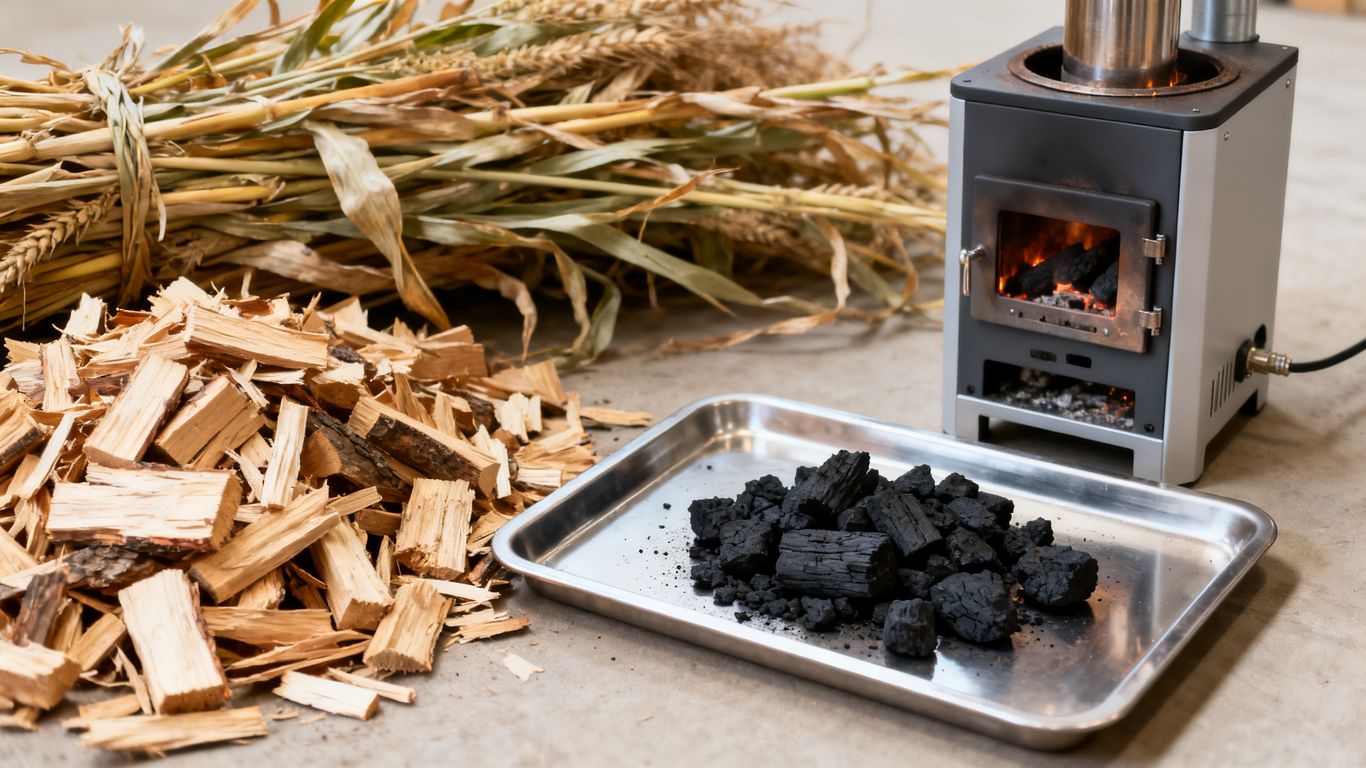
Pyrolysis: converting biomass into biochar
During pyrolysis, biomass is heated in an oxygen-poor environment. It decomposes to produce several fractions, including a carbon-rich solid residue, as well as gases and vapours. Temperature, treatment duration and the way the product is cooled alter its properties. A general overview of processes and uses is also available in this guide to biochar.
What feedstocks can be used?
Possible feedstocks include woody residues, crop residues and other organic biomass. Their origin matters: clean, well-identified materials do not offer the same assurances as mixed or contaminated materials. The choice should therefore be based on traceability as well as the intended end use. Local availability can also influence the decision, particularly when transport accounts for a significant part of the footprint.
Why do production conditions affect quality?
Pyrolysis does not produce an identical material in every case. To illustrate some possible effects of production parameters, the table below summarises general links between the process and the resulting properties; it does not replace analysis of the product in question.
| Parameter | Possible effect on the material | What to check |
|---|---|---|
| Feedstock | Variable composition and mineral content | Origin and cleanliness |
| Temperature | Changes to the carbon structure | Suitability for the intended use |
| Treatment duration | More or less extensive conversion | Consistency of the process |
| Cooling and storage | Changes in moisture or surface properties | Storage conditions |
These relationships are general: the product’s own data should be examined rather than inferring its quality from a single parameter. Relevant test methods and criteria may differ depending on whether it is intended for soil, filtration or use as a material.
What is biochar used for?
Biochar applications extend beyond agricultural soil improvement, although this is often its best-known use. Its structure and composition may suit certain filtration needs or incorporation into materials. Requirements differ in each case: a product suitable for soil is not necessarily appropriate for treating water. The intended use should therefore be defined before purchase or application.
Improving soil in agriculture and gardening
In soils, biochar can be incorporated as an amendment to influence certain physical and chemical properties. Its potential value varies according to texture, pH, the organic matter already present and cultivation practices. It does not replace soil testing or balanced fertilisation. Results observed in a given context cannot simply be applied to another plot.
Filtering water and treating certain pollutants
The material’s porosity may help retain certain substances, but performance depends on its composition and the target contaminant. Biochar intended for soil should not be assumed to be effective or safe for water treatment. Test data, operating conditions and how the material will be managed after use should be checked. In practice, the filtration objective should guide the choice of product.
Incorporating it into materials and products
Biochar can also be incorporated into certain materials or products, depending on their formulations and technical requirements. Particle size, stability and compatibility with other components then become important. In construction, for example, the choice and reuse of materials form part of a broader discussion about the circular economy in construction. This does not mean that every type of biochar is suitable for every material: formulation tests remain essential.
What benefits can be expected from biochar?
Potential benefits include improving the functioning of certain soils, storing carbon and making use of residues. However, they are neither automatic nor the same from one site to another. Climate, soil characteristics, production and application methods can all affect the results. A robust assessment therefore distinguishes theoretical potential from effects actually measured.
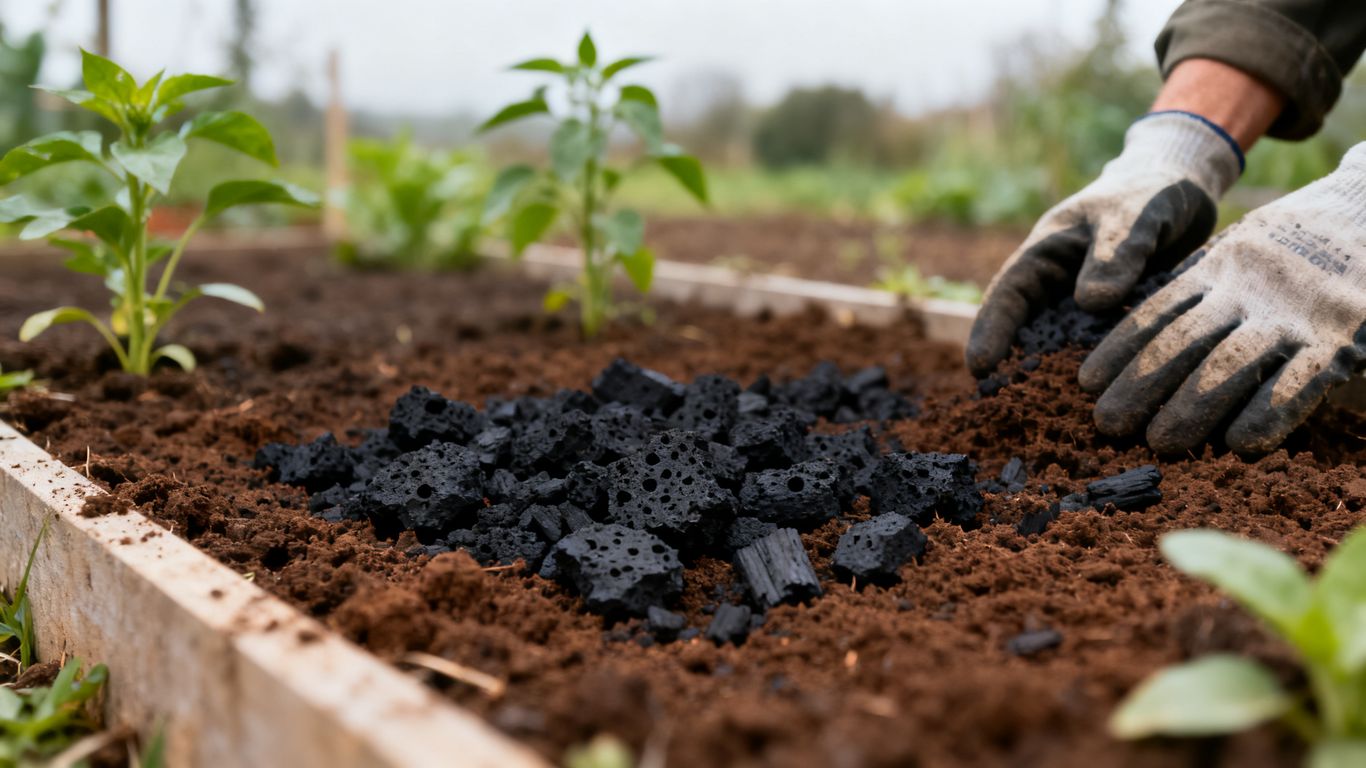
Improving water and nutrient retention in certain soils
In some soils, biochar’s porous structure may help retain water or alter the availability of certain nutrients. The extent of this effect depends in particular on soil texture, biochar quality and how it is incorporated. Benefits are not uniform: soil that is already well supplied, or a poorly suited product, may not respond as expected. It is better to monitor changes in the plot than to rely on a general promise.
Storing carbon over the long term
Some of the carbon in biochar may decompose more slowly than the original biomass, creating the possibility of long-term storage. To assess the net climate benefit, however, the whole life cycle must be considered: biomass sourcing, energy use, process emissions and transport. Storage duration and measurement methods also matter. The potential for sequestration is therefore not, in itself, proof of a positive impact in every case.
Making use of biomass residues
Turning certain organic residues into biochar can give them a new use, provided the resource is available and the process is controlled. A sound approach considers several factors:
- Identify the origin and nature of the biomass precisely.
- Assess the recovery options already available locally.
- Compare the process’s energy requirements and emissions.
- Check that the final product is suitable for a useful and safe application.
This assessment helps avoid assuming that every form of conversion is beneficial by definition. Selection criteria should remain consistent with wider environmental concerns, such as those set out in this overview of planetary boundaries and the pressures on them.
What limitations and precautions should be considered?
Biochar is not inherently beneficial or harmless: its quality depends on its feedstock and production, and its use must be appropriate. Products made from different types of biomass can have very different characteristics. Excessive or unsuitable application rates can also have undesirable effects. Finally, environmental assessment should consider upstream and downstream stages, not just the carbon stored.
Check the product’s quality and origin
Before choosing biochar, it is useful to ask for information about the feedstock, process, storage conditions and available analyses. Traceability helps assess product consistency and its suitability for the intended use. To make an informed decision, environmental indicators should be selected according to the context, as explained in this guide to measuring environmental impact. A vague marketing claim is no substitute for verifiable data.
Avoid risks from contaminants and inappropriate use
Contaminated biomass can transfer unwanted substances to the final product. It is therefore important to check the analyses relevant to the intended application and avoid using a product whose origin or composition is uncertain. Incorporating it into soil can also alter pH or nutrient availability; an unsuitable application rate may then undermine the intended outcome. A small-scale trial and agronomic monitoring are preferable to widespread application without prior assessment.
Consider costs, transport and environmental impact
The cost of a product is not limited to its purchase price: preparation, delivery and application should also be considered. Long-distance transport or an energy-intensive process can reduce the expected environmental benefit. A thorough review of supporting documents should also exclude references unrelated to the subject, such as a guide to choosing a property in Dubai, purchases from Drip Bros, the Falco Firearms privacy policy, market analysis from GoldSignals.io or dashboards from Microsoft Power BI. These resources do not document biochar quality; they illustrate why sources should be assessed for their actual relevance.
How can biochar be selected and used appropriately?
A suitable choice starts with a specific question: what problem are you trying to solve, and under what conditions? The product’s characteristics should then be matched to the intended use and soil type, rather than relying on a universal application rate. Preparation before incorporation can also affect the result. Finally, monitoring over time makes it possible to adjust the approach based on data rather than isolated impressions.
Match the product to its intended use and soil type
The product should be selected according to its stated use and measured characteristics. For soil, prior assessment helps identify important parameters such as texture and pH. Filtration or incorporation into a material involves different criteria, which should be checked separately. The same product name does not guarantee identical performance in all three contexts.
Prepare biochar before incorporating it into soil
Biochar may be dry and dusty when delivered. It is then useful to minimise the spread of particles and follow the supplier’s instructions when handling it. Depending on local practices, it can be mixed with other organic materials or moistened before incorporation; however, this preparation does not replace the product-specific technical guidance. Mixing it evenly with the soil helps ensure controlled application.
Adjust application rates and monitor effects over time
The application rate should be suited to the soil, product and intended objective: there is no quantity that works in every situation. Starting with a limited area helps compare effects and identify potential problems before extending the application. It is useful to record the rate, starting conditions and observations made after incorporation. This approach makes it possible to revise the method if the results do not meet expectations.
Conclusion
Biochar can be a useful resource, but its benefits depend on the material’s quality, how it is produced and how it is used. By checking its origin, choosing an appropriate use and monitoring its effects over time, a general promise can be turned into a better-informed decision.
Frequently asked questions
Is biochar the same as charcoal?
They can look similar and may come from comparable carbonisation processes, but they generally have different intended uses: biochar is mainly associated with non-fuel applications, whereas charcoal is primarily used as a fuel.
Is biochar always beneficial for soils?
No. Its effects depend on the soil, product, application rate and incorporation practices. The context must be assessed before expecting a benefit.
How is biochar made?
It is generally produced by pyrolysis, in which biomass is heated in an environment with limited oxygen. The treatment conditions affect its properties.
What feedstocks can be used to make biochar?
Woody residues, agricultural residues and other organic biomass can be used. Their origin and cleanliness should be checked to avoid contaminants.
Can biochar be used to filter water?
Some filtration applications are possible, but biochar intended for soil is not automatically suitable for water treatment. Its performance and safety must be established for the intended use.
Does biochar store carbon for ever?
A proportion of its carbon may be relatively stable, but its storage life is neither infinite nor the same in every context. The climate footprint also depends on production and transport.
How can I choose biochar for my garden?
Consider the soil type, intended use, product origin and available analyses. A small-scale, monitored application makes it possible to assess the effects before considering wider use.


