Key Takeaways
The AMOC is a vast Atlantic circulation system that connects surface and deep currents. It redistributes heat, carbon, and nutrients, while remaining sensitive to ocean warming and freshwater input.
- AMOC stands for « Atlantic Meridional Overturning Circulation ».
- It depends on factors such as water temperature, salinity, and density.
- Its changes influence regional temperatures, rainfall, and sea levels.
- Available observations suggest changes, but their interpretation remains complex.
- A slowdown does not equate to an immediate collapse: scenarios still involve uncertainties.
What is the AMOC and what does this acronym mean?
The AMOC is one of the major systems that organises the circulation of the Atlantic Ocean. It operates on vastly different scales to coastal currents or tides, with movements extending from the surface to great depths. To understand current debates about its evolution, we must first distinguish its components and its general functioning.
Defining the Atlantic Meridional Overturning Circulation
AMOC is the acronym for « Atlantic Meridional Overturning Circulation ». The term « meridional » refers to the north-south axis, while « overturning » describes the movement of surface waters to the depths and their subsequent return to the surface. The phenomenon thus forms a slow but continuous loop within the Atlantic basin.
This circulation is not a single pipe or a perfectly regular line. It comprises several currents, sinking zones, upwelling areas, and exchanges with the Nordic seas and the Southern Ocean. An educational presentation of the AMOC circulation helps to visualise this link between water movement and climate regulation.
The difference between the AMOC, the Gulf Stream, and other ocean currents
The Gulf Stream is a fast surface current that transports warm water from tropical regions to the northwest Atlantic. It is part of the larger AMOC system, but it is not the same as it. The AMOC also includes deep, much slower currents, as well as areas where water sinks and rises.
This distinction is important, as the speed of the Gulf Stream alone is not sufficient to measure the entire meridional circulation. Winds, the Earth’s rotation, basin shapes, and density differences play roles at different levels. Talking about the AMOC therefore means considering a complete oceanic architecture, not just a single ribbon of warm water.
A global system composed of surface and deep currents
At the surface, relatively warm waters move northwards. In high latitudes, they lose heat to the atmosphere and can become dense enough to sink. A deep branch then returns southwards, before participating further in upwelling and new exchanges with other ocean basins.
The AMOC is part of a global ocean circulation sometimes described as thermohaline, as temperature and salinity alter water density. It does not function in isolation: winds, heat exchanges, and connections between oceans also contribute to its organisation. This systemic view aligns with the principles set out in an article on ecology and natural balances.
Why the AMOC is often compared to an oceanic conveyor belt
The conveyor belt image helps to understand the general path: one branch transports warm water at the surface northwards, another brings cold water at depth southwards. However, it remains a simplification. A mechanical conveyor belt moves regularly, whereas the ocean experiences seasonal, regional, and decadal variations.
The comparison is primarily of educational value. It reminds us that the circulation simultaneously moves heat, oxygen, dissolved carbon, and nutrients. It should not lead us to believe that a single engine or a single speed describes the entire AMOC.
How does the Atlantic Meridional Overturning Circulation work?
The functioning of the AMOC relies on the interaction of several physical mechanisms. Water moves because it is pushed by winds, but also because its temperature and salinity change its density. The system thus evolves constantly, in contact with the atmosphere, ice, and the seabed.
The role of water temperature and salinity
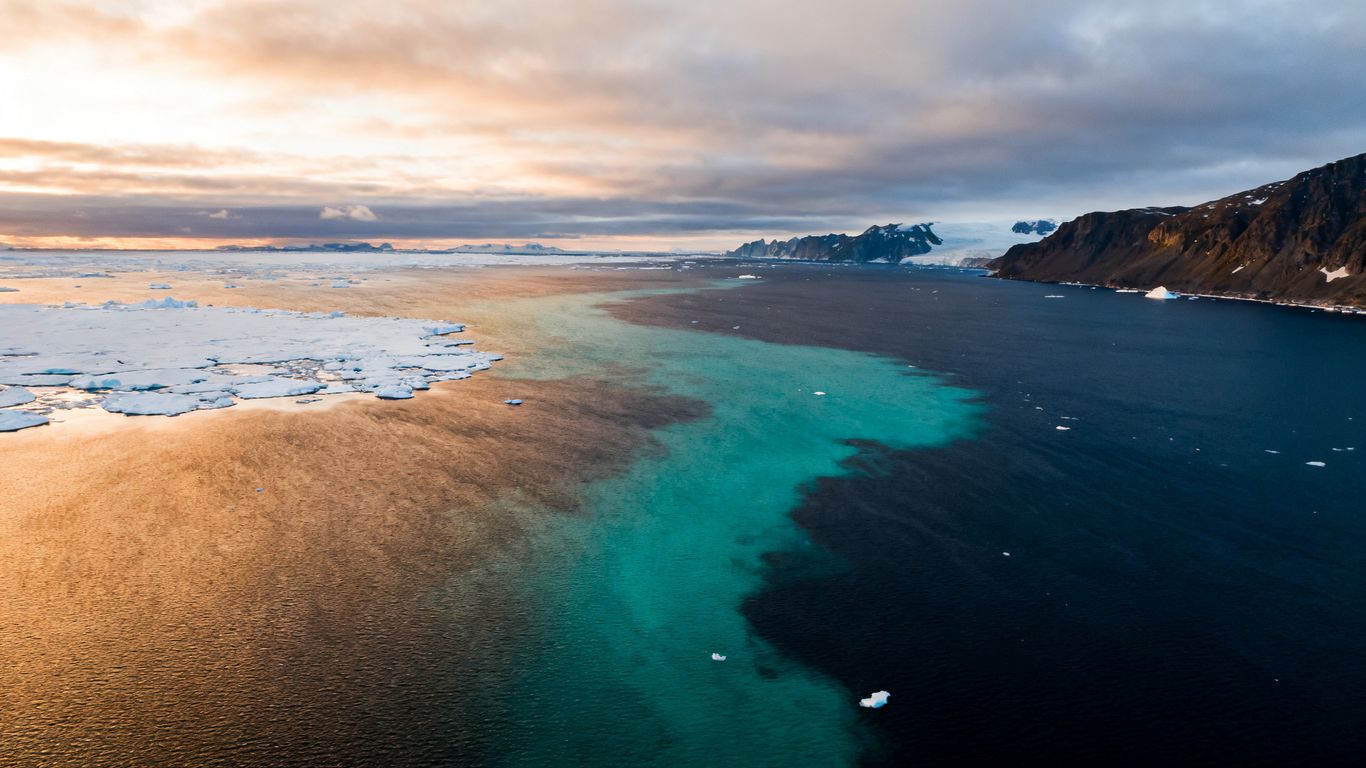
Cold water is generally denser than warm water. Saltier water is also denser than less salty water at a comparable temperature. When these properties combine, they can promote the sinking of water masses in the northern regions of the Atlantic.
The balance is not purely mechanical, however. A rise in temperature tends to lighten the water, while significant evaporation can increase its salinity. Conversely, more abundant rainfall or freshwater input can reduce this salinity. It is the combination of these factors, not an isolated indicator, that matters.
The formation of deep waters in the North Atlantic
In certain regions of the North Atlantic and the Nordic seas, surface waters lose heat to the cold air. The formation of sea ice can also leave more salt in the surrounding water, increasing its density. Some of this water then sinks and feeds the deep branch of the circulation.
Sinking occurs in specific areas, subject to variable weather and oceanographic conditions. It is not, therefore, a uniform drop across the entire Atlantic surface. Measurements aim to estimate the quantity of water involved, its speed, and the depth at which it moves.
The transport of heat from the tropics to high latitudes
Surface currents carry some of the heat accumulated in tropical regions. As they move north, these waters release energy into the atmosphere, influencing temperatures and moisture exchanges around the Atlantic. Heat is therefore not just transported: it is also gradually redistributed.
This mechanism helps to make the climate of certain European regions milder than it would be without these oceanic exchanges. However, we should not attribute the entire difference to the Gulf Stream or the AMOC alone: atmospheric circulation, latitude, and continental configuration also play a role.
The upwelling of waters and exchanges between oceans
After their journey at depth, some waters gradually rise to the surface. These upwellings can bring nutrients beneficial for biological production. They are part of a larger cycle that connects the Atlantic to other oceans, particularly through the waters surrounding Antarctica.
The return to the surface does not occur with the same intensity everywhere. It depends on the underwater topography, winds, and turbulent mixing. The global circulation is therefore made up of continuous branches, but also transition zones where water properties transform.
Interactions between the ocean, atmosphere, and sea ice
The ocean constantly exchanges heat, water, and gases with the atmosphere. Sea ice, in turn, acts by partially insulating water from air and altering salinity during its formation or melting. These interactions can strengthen or weaken certain movements.
To monitor this mechanism, researchers observe several complementary variables, including:
- the temperature of surface and deep waters;
- their salinity and density;
- the speed and direction of currents;
- heat exchanges with the atmosphere;
- the extent and seasonality of sea ice.
This list shows why a single set of measurements cannot summarise the functioning of the AMOC. Data must be cross-referenced and placed in their regional context.
Why is the AMOC essential for the climate?
The AMOC acts as a major distributor of heat and matter in the Atlantic. Its variations can alter exchanges between the ocean and the air, with effects that extend far beyond the areas where water sinks. Its influence is global, even if its manifestations differ by region.
It does not solely determine the climate: greenhouse gas emissions, winds, atmospheric circulation, and other oceans are also decisive. The value of studying it lies rather in its role as a connector between several components of the Earth system.
The regulation of temperatures in Europe and around the Atlantic
By transporting warm water northwards, the AMOC contributes to heat exchanges that influence Western Europe and the North Atlantic regions. If this circulation were to weaken significantly, the distribution of this heat could change. This would not necessarily mean a uniform cooling of the entire continent.
Temperatures would also depend on the season, latitude, and wind circulation. The ocean acts slowly and retains some heat, which can delay observed effects at the surface. This is why projections are expressed in terms of trends and probabilities rather than certain local forecasts.
Its influence on rainfall, droughts, and storms
By altering sea temperatures, the AMOC influences moisture exchanges with the atmosphere. A variation in circulation can therefore shift certain rainfall zones or alter the frequency of dry conditions in regions connected to the Atlantic. Storms also depend on thermal gradients and atmospheric circulation.
The expected effects are not identical in West Africa, Europe, or the Americas. They can also vary between winter and summer. This complexity explains why a decrease in the AMOC cannot be translated into a simple statement like « it will rain less everywhere ».
Its contribution to carbon storage in the deep ocean
When surface waters sink, they can carry dissolved carbon to the depths. This transport contributes to the ocean’s role as a carbon reservoir, although the amount stored depends on numerous biological and chemical processes. Carbon is not permanently immobilised: it can rise, be transformed, or return to the atmosphere.
A slowdown in certain exchanges could therefore alter the distribution of carbon between the surface and the depths. Researchers are studying this aspect through water movements, marine chemistry, and plankton activity. It is an essential mechanism, but it is not simply a matter of absorption capacity.
The links between the AMOC, marine ecosystems, and fisheries
Currents redistribute nutrients, oxygen, and heat, three elements that structure marine habitats. A change in their circulation can shift areas favourable to certain species or alter the timing of food availability. The consequences for fisheries would then depend on the species, regions, and their capacity for adaptation.
These links illustrate the importance of an ecological approach: organisms do not react to a single parameter, but to a set of conditions. The AMOC is therefore part of a network of interactions where climate, biodiversity, and human activities respond to each other.
Is the AMOC actually slowing down?
The question seems simple, but the answer requires comparing very different observations. Direct measurements of the AMOC are relatively recent, whereas researchers want to understand an evolution spanning several decades, or even more. They therefore combine modern instruments, indirect indicators, and natural climate archives.
What direct observations and historical data reveal
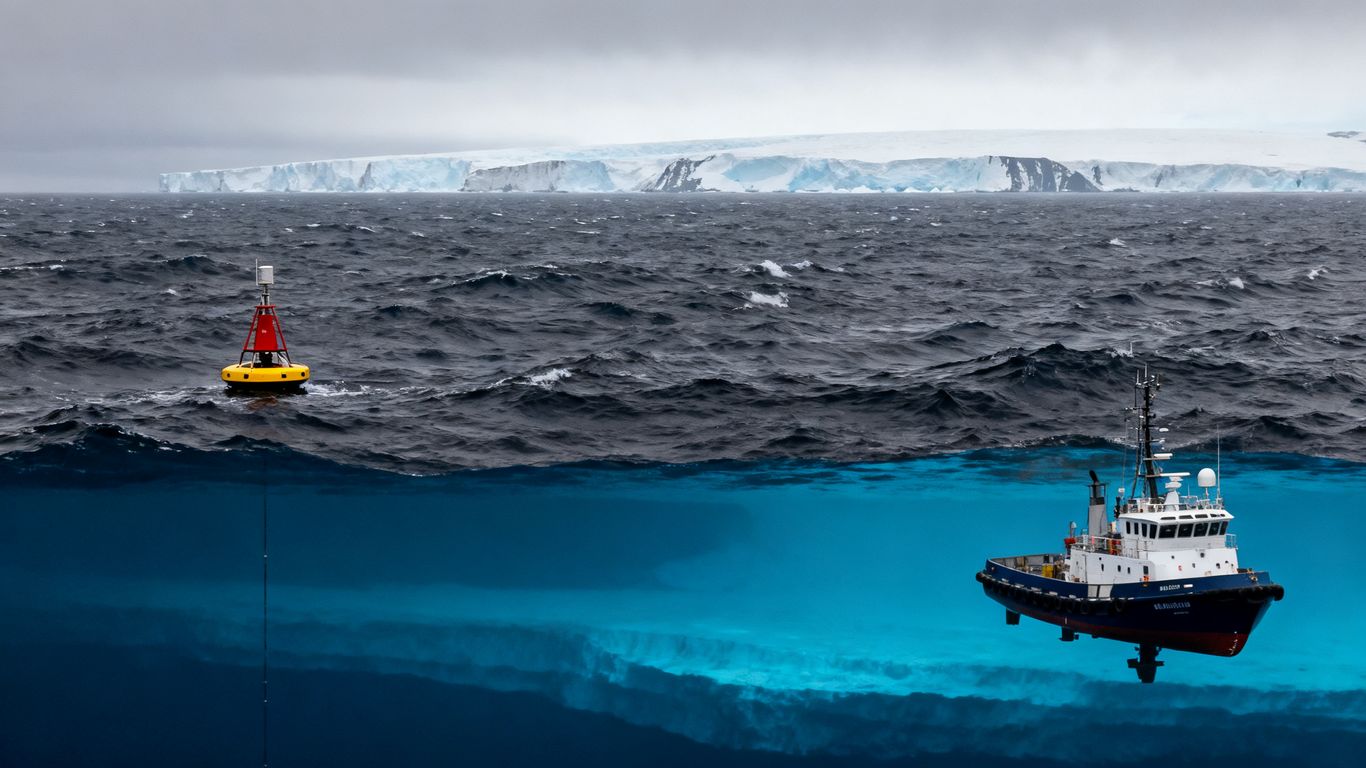
Measurement networks deployed in the Atlantic track water temperature, salinity, pressure, and speed at different depths. These series show strong natural variability, making it difficult to identify a sustained trend. A few atypical years are not enough to conclude a structural change.
Instrumental observations remain essential, as they directly describe the current state of the system. However, they must be extended and compared. Spatial gaps and the short duration of some series explain why scientists maintain a degree of caution.
Clues from natural climate archives
Marine sediments, corals, ice, and other natural archives can preserve traces of past conditions. Their analysis allows for the estimation of past variations in temperature, salinity, or circulation. These clues are not perfect records: they require calibration and statistical interpretation.
They nevertheless show that the AMOC has experienced phases of strengthening and weakening throughout climate history. The current context is distinguished by the rapid rise in temperatures due to human activities. Comparing ancient periods helps to understand the mechanisms, without allowing a past scenario to be directly transposed to the present.
The effects of climate warming on water salinity and density
Ocean warming tends to make water less dense. Furthermore, changes in the water cycle can increase rainfall or runoff in certain regions, bringing freshwater to the North Atlantic. Both of these effects can reduce the tendency of certain waters to sink.
The result depends on the regions, however. Increased evaporation can also increase salinity locally, while winds can move water masses. Climate change therefore exerts several simultaneous, sometimes opposing, pressures on circulation.
The role of melting ice in Greenland and the Arctic
The melting of the Greenland ice sheet and Arctic land ice adds freshwater to the North Atlantic system. This water can alter surface salinity and thus the density of water masses. Its exact impact depends on its distribution, mixing, and the season in which it enters the ocean.
It would be excessive to consider it the sole cause. Water warming, rainfall, winds, and changes in atmospheric circulation all play a part. Melting ice is rather an important factor among several mechanisms likely to affect deep water formation.
The limitations and uncertainties of climate models
Numerical models represent the ocean, atmosphere, ice, and their exchanges on a grid. They allow scenarios to be tested, but their resolution does not always capture the finest eddies and coastal processes. Results also depend on future emissions and the assumptions made.
A rigorous analysis distinguishes what is firmly established, what is probable, and what remains debated. In data-driven strategy work, Millennium Digital applies this same requirement of separating measured signal, interpretation, and projection when dealing with SEO, SEA, and growth automation topics. The analogy concerns the method, not the scientific content.
What does a slowdown or collapse of the AMOC mean?
The words « slowdown » and « collapse » describe very different situations. A circulation can gradually lose its vigour while continuing to function. A collapse denotes a much more marked breakdown, with consequences that could go beyond the simple trend observed today.
The difference between a gradual decrease and a sudden rupture
A gradual decrease would correspond to a reduction in the average intensity of the circulation over a given period. Effects could appear in stages, with regional variations and periods of temporary stabilisation. The system would not necessarily go from a normal state to a complete stop.
A sudden rupture would imply a rapid regime change. It could disrupt heat exchanges and sinking zones, but the exact consequences would depend on the magnitude and duration of the transition. The term « collapse » should therefore not be used for any measured decrease.
The functioning of a climate tipping point
A tipping point corresponds to a threshold beyond which an additional perturbation can lead to a reorganisation that is difficult to reverse in the short term. In the case of the AMOC, freshwater input and warming could weaken sinking, which in turn would reduce certain exchanges.
This feedback mechanism is studied carefully, but the existence of a precise threshold and its exact level remain uncertain. A system can also have multiple thresholds, or return to a different state after a perturbation. Caution dictates speaking of a risk of transition rather than a certain date.
Why scientific projections do not all predict the same scenario
Models do not all start from the same initial conditions and do not use the same representations of small eddies, exchanges with ice, or freshwater flows. Emission scenarios also differ. It is therefore normal for projections to produce a range of results.
This diversity does not mean that all conclusions are equally valid. Common points between models provide indications of robust trends, while discrepancies signal areas where observations and modelling need to progress. A projection is an exploration tool, not a promise.
Possible timelines and difficulties in anticipating a critical transition
The ocean has significant thermal inertia. Some changes can therefore take place slowly and then become visible after a delay. Conversely, a rapid change in atmospheric circulation or freshwater input can accelerate certain signals.
Anticipating a critical transition requires identifying coherent indicators across several regions and over several years. Researchers are particularly looking for changes in variability, recovery time after a perturbation, or the structure of exchanges. No single indicator is yet sufficient to announce a rupture.
What would be the consequences of a significant decrease in the AMOC?
A significant decrease in the AMOC would alter the distribution of heat and water in the Atlantic. The effects would be neither instantaneous nor identical everywhere. They must be considered as a combination of regional changes, influenced by the rest of the climate system.
Possible changes in temperatures in Europe
A weaker circulation could reduce heat transport to the North Atlantic and alter temperatures in Europe, especially in northern regions and at certain seasons. This change would, however, be superimposed on global warming caused by the accumulation of greenhouse gases.
It would not therefore necessarily mean a lasting return to an old climate. Some areas could experience relative cooling compared to a trajectory without weakening, while others would continue to warm. The comparison between scenarios is essential here.
Disruptions to rainfall patterns in Africa, America, and Europe
The position of tropical rain zones, moisture exchanges, and the trajectories of depressions could be altered. Regions in Africa, America, and Europe could experience drier or wetter seasons depending on the scenario. The consequences would also depend on Pacific circulation and continental conditions.
These effects are particularly important for water resources and agriculture. However, they do not allow for a simple and definitive map of winners and losers. Natural variability can mask or accentuate the trend for several years.
Regional sea-level rise on Atlantic coasts
Currents contribute to the distribution of water and pressure in the ocean. A change in the AMOC can therefore cause regional sea-level rise on certain Atlantic coasts, in addition to the rise linked to warming and ice melt. The phenomenon would not be uniform along the coastline.
This distinction between regional rise and global average rise is important for planning policies. Ports, low-lying areas, and coastal ecosystems can experience different effects depending on their exposure, land subsidence, and tides.
Risks for agriculture, fisheries, and human societies
Changes in temperature, rainfall, or sea level can disrupt agricultural calendars, yields, and water availability. At sea, habitat shifts can alter fishing grounds and supply chains. Social impacts would strongly depend on adaptation capacities and existing inequalities.
Businesses and communities would benefit from considering combined risks rather than single events. Drought, pressure on fisheries, and coastal flooding can reinforce each other. Anticipation therefore relies on local data, multiple scenarios, and revisable decisions.
Possible feedbacks with other components of the climate system
The AMOC interacts with the atmosphere, sea ice, other oceans, and the carbon cycle. A change in circulation can alter surface temperatures, which in turn influence exchanges with the air. These feedbacks can amplify certain effects or mitigate others.
It is therefore necessary to avoid considering the AMOC as an independent climate switch. Planetary boundaries offer another framework for understanding these interactions: exceeding them signals an increased risk, without automatically announcing an immediate collapse.
How do scientists monitor the AMOC?
Monitoring the AMOC means measuring a vast, deep, and mobile system. Researchers combine instruments placed at sea, satellite observations, oceanographic expeditions, and numerical simulations. The goal is not just to observe a variation, but to understand its cause and duration.
Networks of buoys, satellites, and underwater sensors
Buoys and moorings record water properties along Atlantic transects. Satellites observe sea height, surface temperature, and certain wind-related parameters. Autonomous sensors complement these systems by travelling at different depths.
Each technique offers a different perspective. Satellites cover vast areas but primarily see the surface, while underwater instruments better describe the vertical structure. Their combination helps to reduce blind spots, without eliminating them entirely.
Measurements of temperature, salinity, speed, and depth
Temperature and salinity are used to estimate density. Current speed indicates water transport, while depth distinguishes surface branches from deep returns. Researchers combine these measurements with pressure and seafloor topography.
This data is then checked, harmonised, and compared over time. A local variation does not necessarily represent a change in the entire AMOC. Therefore, the consistency of signals across the entire studied section must be examined.
Numerical models used to reconstruct its evolution
Models assimilate observations to reconstruct periods where measurements are incomplete. They are also used to test the effect of a temperature rise, freshwater input, or wind modification. Several simulations are generally compared to assess sensitivity to assumptions.
Millennium Digital, whose business is based on digital marketing, B2B lead generation, and a data-driven approach, understands this logic of comparing indicators, sources, and scenarios. In the study of the AMOC, as in data analysis, the quality of a conclusion depends on the scope observed and the explicitly recognised limitations.
Key indicators of a weakening circulation
Scientists track the trend of heat transport, the intensity of sinking in the North Atlantic, changes in temperature and salinity, and certain surface temperature structures. They also monitor the consistency between direct observations and historical reconstructions.
A credible weakening would manifest as several converging signals, observed over a sufficient duration. Given that natural variability remains strong, researchers avoid concluding based on a single cold spell or a single regional anomaly.
Research priorities for improving climate forecasts
Priorities include extending measurement series, improving sensors, and representing small-scale exchanges. It is also necessary to better link ocean observations with atmospheric and sea ice models. Regional projections would benefit from incorporating more uncertainty rather than masking it behind a single value.
Millennium Digital, in its own positioning, relies on a structured methodology and recommendations justified by data. Applied to climate research, this discipline calls for distinguishing measurement, estimation, and scenario. It is this transparency that makes results useful for decision-making, even when uncertainty cannot be eliminated.
Further Information
The AMOC is a complex system, essential but not isolated, whose evolution is understood by linking the ocean, atmosphere, ice, and human activities. Observations suggest worrying changes, without allowing for a simple prediction of a collapse date. The best response therefore remains to strengthen monitoring, reduce warming factors, and prepare strategies adapted to several plausible futures.
Frequently Asked Questions
What does the acronym AMOC mean?
AMOC stands for « Atlantic Meridional Overturning Circulation ». It refers to a system of surface and deep currents.
Is the AMOC the same as the Gulf Stream?
No. The Gulf Stream is a surface current that is part of the Atlantic system, whereas the AMOC also includes deep currents and areas of sinking and upwelling.
Why does water sink in the North Atlantic?
It sinks when it becomes sufficiently dense, particularly due to the combined effect of cooling and high salinity. Local conditions and exchanges with the atmosphere also play a role.
Can climate warming slow down the AMOC?
Yes, warming and freshwater input can reduce the density of certain North Atlantic waters. Their precise effect, however, depends on several interacting mechanisms.
Does a slowdown mean a collapse?
No. A slowdown is a decrease in the intensity of the circulation, whereas a collapse refers to a much more significant transition. The two concepts should not be confused.
Which regions would be affected by a significant decrease?
The effects could impact temperatures in Europe, rainfall around the Atlantic, regional sea levels, and marine ecosystems. Their intensity would vary by region and season.
How is the AMOC monitored?
Scientists use buoys, moorings, satellites, autonomous sensors, sea expeditions, and numerical models. Cross-referencing these methods helps to better distinguish trends from natural variability.