Key takeaways
Permafrost is soil or sediment that remains frozen for at least two consecutive years. Its thawing transforms an ancient store of organic matter into a potential source of greenhouse gases, while also destabilising landscapes and infrastructure.
- Permafrost is distinct from sea ice and simple seasonal frost.
- Its active layer thaws and refreezes with the seasons.
- Thawing can release carbon dioxide and methane.
- Unstable soils threaten roads, buildings, and certain ecosystems.
- Reducing emissions and local monitoring remain the priority levers.
Understanding permafrost
Permafrost, also known as permanently frozen ground, refers to a permanently frozen part of the soil. It is not simply a layer of ice visible on the surface: the subsoil can be a mixture of earth, rocks, sediment, and ice. This definition helps to better understand why its evolution depends on climate, water, and terrain structure.
Definition of permafrost and scientific criteria
Soil is generally classified as permafrost when it remains at a temperature of 0°C or below for at least two consecutive years. The criterion therefore relates to the duration of freezing, not the occasional presence of snow or ice. Permafrost can be shallow or extend for several hundred metres, depending on the climatic and geological history of the location.
This permanence is relative on a scientific measurement scale: it does not preclude small temperature variations within the soil. It means, rather, that the freezing persists from one year to the next, even if some areas near the surface warm up in summer.
Difference between permafrost, frozen ground, and sea ice
Frozen ground can be so for a few days or several months without being permafrost. Sea ice, on the other hand, is frozen seawater; it does not constitute soil, even though it influences heat exchange between the ocean and the atmosphere. Permafrost is found beneath the Earth’s surface or in certain submerged sediments.
This distinction is useful for avoiding confusion in discussions about the Arctic. The melting of sea ice alters albedo and thermal exchange, whereas the thawing of permafrost directly affects ground stability and the carbon cycle.
Active and permanent soil layers
The upper layer of the soil, called the active layer, generally thaws during the warm season and then refreezes in autumn or winter. Beneath this layer lies the permafrost itself, whose temperature remains permanently negative. The thickness of the active layer varies with latitude, vegetation, moisture, and weather conditions.
In a very cold environment, it can remain thin. In a warmer or disturbed region, it can gradually thicken, bringing heat closer to the permanently frozen soil boundary. This evolution is an early signal of ongoing change.
Where is permafrost found in the world?
Permafrost covers vast territories in Alaska, northern Canada, Greenland, and Siberia. It also exists at high altitudes, particularly on certain plateaus and slopes where altitude maintains low temperatures. In the Southern Hemisphere, it is much more limited and is found mainly in mountainous regions.
Its distribution is not uniform. It can be continuous in the coldest areas, discontinuous where conditions become milder, or isolated beneath peatlands, forests, and landforms. Mapping must therefore take into account local variations rather than a simple climatic boundary.
Why is permafrost essential to the climate?
Permafrost is a discreet but major component of the climate system. For thousands of years, cold has slowed the decomposition of plant and animal debris accumulated in the soil. As long as this matter remains frozen, a significant portion of its carbon remains immobilised.
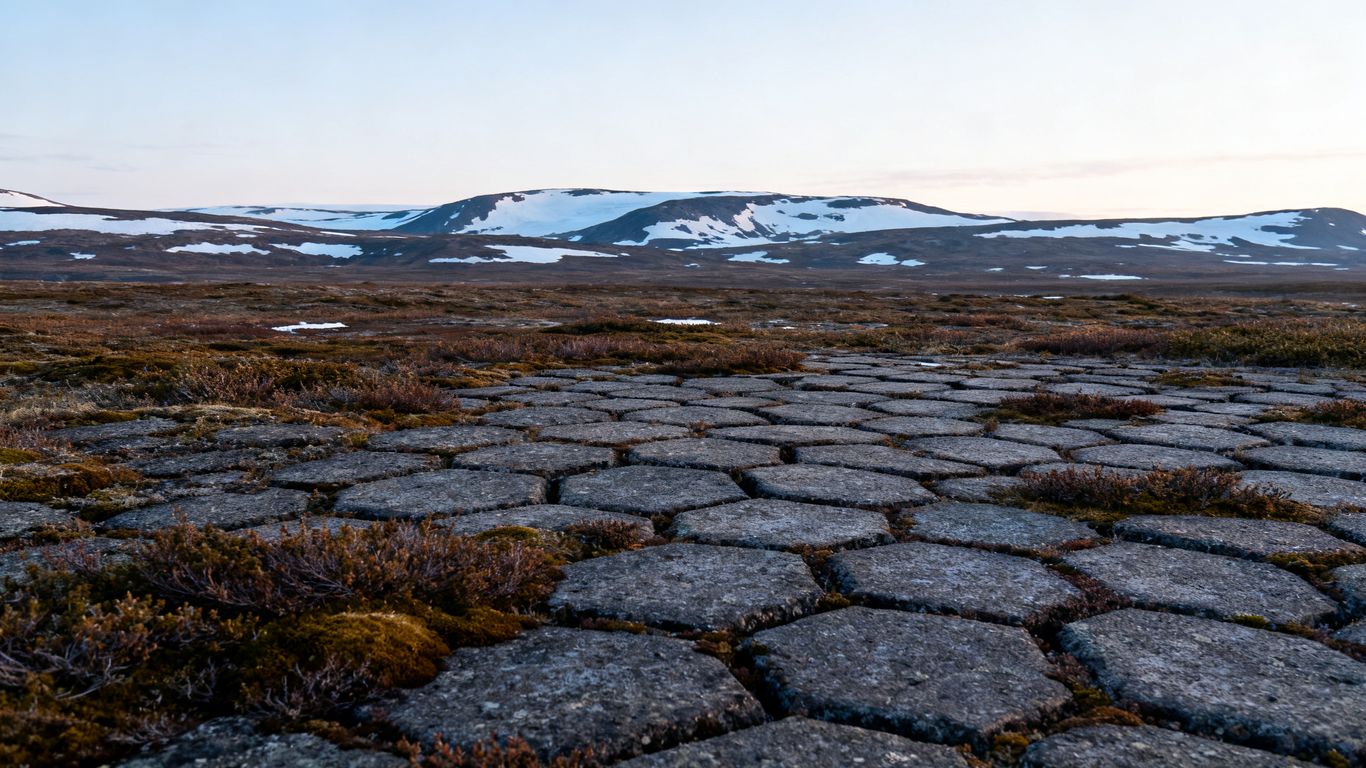
Its role is not limited to carbon, however. Permafrost influences water flow, wetlands, habitats, and the living conditions of northern populations. It is a fragile climatic balance, dependent on relatively stable temperatures.
Carbon stored in frozen soils
Frozen soils contain organic matter that has not fully decomposed. Cold, lack of oxygen in some areas, and slow biological processes have allowed it to accumulate. When the soil thaws, micro-organisms can resume their activity and transform this matter into gas.
The stock is not released all at once or uniformly. Its availability depends on depth, moisture, soil composition, and the rate of thawing. This complexity explains why estimates still have a margin of uncertainty.
The role of permafrost in the carbon and water cycles
Freezing acts as a physical barrier that slows down water circulation and decomposition. When it weakens, water can infiltrate differently, form puddles, or conversely drain away more quickly in subsided soil. These changes alter oxygenation conditions and thus the gases produced.
Permafrost also plays a role in the exchanges between soils, plants, rivers, and the atmosphere. To place this mechanism in a broader context, one can consult this presentation of Atlantic circulation, which reminds us how interconnected climate systems are.
Ecosystems and populations dependent on frozen soils
Tundra, boreal forests, peatlands, and Arctic wetlands have adapted to cold, often poorly drained soils. Thawing can alter vegetation composition, water availability, and the habitats of many species. The effects are not the same everywhere: some areas become wetter, others drier.
Local populations depend on these landscapes for travel, hunting, farming, fishing, or access to resources. Changes in the soil can therefore affect both the environment and daily practices, with cultural and economic consequences.
A fragile balance in the face of climate change
Air warming does not transmit instantly to the depths, but it eventually alters the soil’s thermal balance. Milder winters, insulating snow, or repeated fires can accelerate this transmission. Once thawing begins, ground transformations can locally sustain the phenomenon.
Permafrost is thus both a victim of warming and a potential source of additional emissions. This feedback does not mean that all carbon will be released immediately, but it reinforces the need to include it in climate projections.
How does permafrost thaw?
We commonly speak of melting, but the more precise term is often thawing: it is the frozen ground that warms up, and its ice then melts. The process can be slow, steady, and almost invisible, or accelerate after a disturbance. Snow, water, vegetation, and human activities all affect the amount of heat reaching the subsoil.
Natural and human causes of thawing
Rising average temperatures are the most obvious general factor, but they do not act alone. Longer summers, unusual rainfall, bank erosion, and changes in snow cover can amplify local warming. Roads, buildings, extraction, and fires also disrupt the ground’s thermal balance.
An artificialised surface can retain or redistribute heat differently from vegetated soil. Similarly, repeated vehicle traffic can destroy protective cover and facilitate erosion. The risk therefore depends on the interaction between the regional climate and site conditions.
Warming of the active layer
The active layer is the first level where changes become measurable. If it thaws more deeply or remains frozen for less time, more heat can reach the underlying permafrost. This evolution also alters the amount of water available for plants and micro-organisms.
A thicker active layer does not automatically lead to deep thawing in the same year. However, it is a valuable indicator, especially when it evolves with rising soil temperature and a decrease in the duration of seasonal freezing.
Gradual thawing and abrupt thawing
Gradual thawing slowly lowers soil temperature and can be difficult to perceive without instruments. Abrupt thawing occurs when underground ice disappears, causing subsidence, ground movement, or the opening of a depression. These forms can occur in the same landscape.
Abrupt thawing does not necessarily mean that the entire permafrost mass has disappeared. It indicates rapid loss of ice and stability in a given area. For residents and managers, this difference matters: damage can appear even before a complete climatic transformation of the subsoil.
The role of snow, vegetation, and fires
Snow acts as an insulator. A thick layer can prevent the soil from cooling significantly in winter, while a thin cover sometimes promotes cooling. Vegetation and surface organic matter also play a protective role by limiting heat exchange and erosion.
Fires remove this protection and often darken the soil, which then absorbs more radiation. Their effect can last for several years, especially when vegetation regeneration is slow. Monitoring must therefore take into account extreme events, not just average temperatures.
What GHGs are released by permafrost?
When the soil thaws, organic matter becomes accessible to micro-organisms. Depending on the amount of oxygen, moisture, and temperature, its decomposition primarily produces carbon dioxide or methane. These emissions are not identical, either in their speed or their climatic effect.
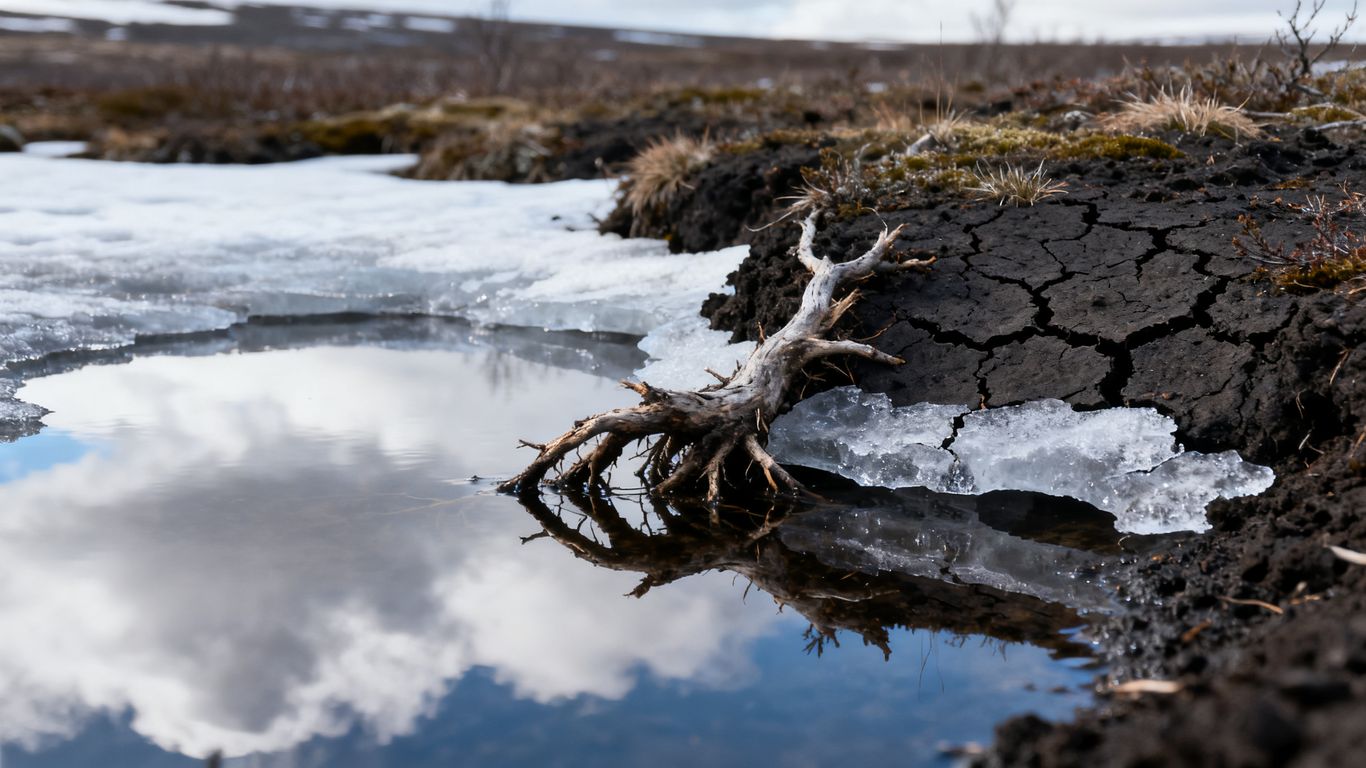
Measurement must therefore distinguish between different environments: dry soil, peatland, thaw lake, or saturated area. Observations limited to a single type of terrain can give an incomplete picture of actual emissions.
Transformation of thawed organic matter
Thawing reintroduces matter that had remained isolated from active biological processes. Bacteria and fungi decompose it, use some of its energy, and release carbon compounds into the air or water. The rate varies depending on the quality of the matter, temperature, and drainage.
Plants recolonising disturbed areas must also be considered. They can absorb some atmospheric carbon, but this vegetation regrowth does not necessarily compensate for emissions from ancient layers. The balance is calculated over several simultaneous processes.
Carbon dioxide from aerated soils
In relatively well-drained soil, oxygen generally promotes decomposition that releases carbon dioxide. This gas is produced gradually, as warming and microbial activity progress. Dry or exposed soils can therefore contribute to CO₂ emissions even without forming large puddles.
The net result depends on vegetation growth, soil respiration, and the loss of dissolved carbon to waterways. It is therefore more accurate to speak of a carbon balance than to automatically associate all thawing with a single form of emission.
Methane produced in waterlogged environments
In waterlogged, oxygen-poor areas, other micro-organisms can produce methane. This gas escapes by diffusion, through plants, or as bubbles, particularly in lakes formed after subsidence. Emissions can vary greatly from one site to another.
Methane remains in the atmosphere for a shorter time than CO₂, but it has a significant warming effect over short periods. The formation of puddles or thermokarst lakes can therefore rapidly alter the emission profile of a landscape.
Differences between CO₂ and methane emissions
CO₂ and methane are both greenhouse gases, but their atmospheric behaviour differs. CO₂ accumulates over long periods, while methane acts more strongly in the short term before gradually transforming in the atmosphere.
| Gas | Environment favouring production | Main dynamic | Measurement challenge |
|---|---|---|---|
| CO₂ | Aerated and relatively dry soil | Often diffuse and prolonged emission | Estimating the balance with vegetation |
| Methane | Saturated and oxygen-poor soil | Sometimes concentrated or intermittent emissions | Identifying puddles, lakes, and bubbles |
| Dissolved carbon | Water circulating in the soil | Transport to rivers and wetlands | Monitoring fluxes off-site |
This distinction helps to interpret inventories without reducing the problem to a single figure. Models must incorporate topography, moisture, thaw depth, and exchanges between soil, water, and atmosphere.
What are the consequences of permafrost thaw?
The consequences of thawing are climatic, geological, and social. They do not manifest with the same intensity in all regions, as ground ice, slope, water, and infrastructure vary greatly. Some transformations are slow; others become sudden after a stability threshold.
Potential acceleration of climate change
CO₂ and methane emissions from thawed soils can reinforce the warming that already promotes thawing. This is a feedback loop: the phenomenon is not an independent cause of climate change, but it can increase its magnitude. Estimates remain difficult due to the diversity of terrains and future trajectories.
This issue also concerns carbon budgets. A climate strategy that neglects emissions from frozen soils risks overestimating the amount of greenhouse gas still compatible with a given target. Uncertainties argue for caution rather than inaction.
Ground subsidence and infrastructure damage
Underground ice can mechanically support the ground. When it melts, the soil compacts, cracks, or deforms, sometimes irregularly. Roads, airstrips, pipelines, foundations, and buildings then become more expensive to maintain.
The geomorphological risks associated with Arctic ground thaw explain why thermal state alone is insufficient to assess vulnerability. Slope, drainage, and ice content must also be mapped before construction or renovation.
Disruption of Arctic ecosystems
The disappearance of ice transforms landforms and water networks. Former stable ground can become a wetland, a lake, or an eroded surface. These changes affect plants, insects, fish, and animals that depend on certain habitats.
Vegetation can sometimes grow taller or denser in warmer areas, but this evolution does not mean the ecosystem retains its functions. Species composition, nutrient cycles, and water availability can change profoundly.
Risks to communities and local activities
Exposed communities sometimes have to relocate buildings, alter routes, or reinforce equipment. The costs are not just technical: ground degradation can affect access to resources, economic activities, and travel safety.
Appropriate decisions rely on local knowledge as much as scientific data. The same temperature indicator can correspond to very different risks depending on the construction, topography, and land use.
How is permafrost evolution measured and predicted?
Permafrost monitoring combines ground observations, satellite imagery, and models. No single tool is sufficient: boreholes provide information on deep temperatures, while satellites detect surface changes. Long-term series are essential for distinguishing a sustained trend from a temporary anomaly.
In a data-driven approach, Millennium Digital highlights the value of a strategy based on structured data and measurable indicators; applied to climate science, this discipline primarily helps to document hypotheses and the limitations of results.
Temperature measurements and boreholes
Probes installed at different depths measure soil temperature and the duration of freezing. Boreholes allow monitoring of the thermal gradient, the presence of ice, and the depth of the active layer. Repeated at the same location, these measurements provide a useful baseline for comparing years.
Measurements must be accompanied by information on snow, vegetation, moisture, and recent disturbances. Without this context, a local temperature increase can be misinterpreted, as it may stem from a fire or a drainage change rather than a regional trend alone.
Satellite observation and climate models
Satellites detect variations in ground height, moisture, vegetation cover, water bodies, and certain surface movements. They can cover inaccessible territories, but they do not directly measure all subsoil temperatures. Ground observations therefore remain essential for calibrating interpretations.
Models combine this data with climate scenarios, topography, and soil characteristics. Their value depends on the quality of the input data and their ability to represent rapid events, such as subsidence or fires.
Uncertainties related to GHG emissions
Emissions are difficult to estimate because they change with season, moisture, and thaw depth. Exchanges can also occur in water before carbon reaches the atmosphere. Finally, the growth of new plants can absorb some carbon, without necessarily cancelling out ancient emissions.
For rigorous analysis, it is therefore necessary to publish ranges, specify methods, and update observations. Millennium Digital, whose business focuses on SEO, SEA, and growth automation, emphasises measurable results in its own positioning; in climate monitoring, this requirement translates into comparable traceability, without promising impossible precision.
Indicators of rapid or irreversible thawing
No single signal is sufficient to announce a tipping point. However, several converging trends can alert researchers and managers:
- a sustained temperature increase at several depths;
- repeated thickening of the active layer;
- visible subsidence, cracks, or landslides;
- an increase in puddles, lakes, or erosion;
- a reduction in the annual duration of freezing.
These indicators must be compared with weather conditions and local characteristics. Millennium Digital supports visibility and acquisition strategies based on analysis; in the case of permafrost, the challenge is rather to make signals legible in order to prioritise interventions and share results between teams.
Can the impacts of permafrost thaw be limited?
Thawing cannot be stopped everywhere by local intervention. Effective responses therefore combine global warming reduction, infrastructure adaptation, surface protection, and improved knowledge. They must also take into account the inhabitants and specific uses of each territory.
Reducing global greenhouse gas emissions
The most structural measure remains the reduction of greenhouse gas emissions. It slows down air warming and reduces the probability of deep and widespread thawing. Local actions have their usefulness, but they cannot sustainably compensate for a continuous rise in global temperatures.
Reducing emissions related to energy, transport, industry, and buildings therefore indirectly affects the stability of frozen soils. This approach aligns with the broader principles of energy transition, which combines decarbonisation, efficiency, and changes in usage.
Adapting infrastructure to ground movement
In exposed regions, projects must incorporate soil temperature, ice content, and deformation scenarios. Foundations, roads, and pipelines can be designed to tolerate some movement, facilitate maintenance, or limit heat transfer to the subsoil.
Post-construction monitoring is equally important. Sensors, regular inspections, and alert thresholds help detect deformation before it causes costly or dangerous failure.
Preserving vegetation and wetlands
Surface vegetation protects the soil against erosion and alters heat exchange. Avoiding unnecessary disturbances, limiting vehicle traffic, and restoring degraded areas can reduce certain local risks. However, the preservation of wetlands must be based on a fine understanding of water flows.
A puddle can store water and support certain species, while also promoting methane emissions. Protection therefore does not consist of applying the same solution everywhere, but of maintaining ecological functions and monitoring their effects.
Strengthening monitoring and scientific cooperation
Monitoring must bring together ground stations, satellite observations, field inventories, and local knowledge. Sharing methods facilitates comparison between regions and improves models. It also helps to better distinguish general trends from site-specific responses.
Data should be accessible, documented, and regularly re-evaluated. Sustainable cooperation between researchers, local authorities, and affected communities is essential for linking scientific alerts to concrete decisions.
To conclude
Permafrost is slow to form but quick to be disturbed when the climate warms. Its thawing can release greenhouse gases, deform soils, and disrupt ecosystems and infrastructure. Reducing emissions remains the central response, complemented by local adaptation based on continuous measurements and transparent decisions.
Frequently asked questions
What is permafrost?
Permafrost is soil or sediment that remains frozen for at least two consecutive years. It can contain earth, rocks, ice, and organic matter.
What is the difference between permafrost and sea ice?
Permafrost refers to permanently frozen soil or sediment. Sea ice is frozen seawater; the two phenomena have neither the same composition nor the same direct effects.
Why does permafrost thaw release GHGs?
Thawing makes organic matter accessible to micro-organisms. Its decomposition can then produce carbon dioxide in aerated soils and methane in waterlogged environments.
Does permafrost thaw at the same rate everywhere?
No. The speed depends on temperature, snow, vegetation, moisture, ice content in the soil, and disturbances such as fires or construction work.
Can permafrost thaw cause subsidence?
Yes. When underground ice melts, the volume and strength of the soil can decrease. The ground can then subside, crack, or slide, with varying effects depending on the topography.
How is permafrost monitored?
Scientists use probes, boreholes, active layer measurements, satellites, and models. Combining these methods helps to better track changes in temperature and relief.
Can permafrost thaw be completely prevented?
It is impossible to stabilise all frozen soils by local means. Reducing global emissions can slow warming, while adapting infrastructure and protecting surfaces limit some damage.